Repair or Replace Your AC in Burbank: The Honest Math
Straight answer: Repair your Burbank AC when the fix is small or the unit is young; replace it when a major repair tops about half a new Mitsubishi system's cost and the unit is past 10 to 12 years. Burbank Mitsubishi HVAC runs the honest numbers for 91505 valley homes, so call (213) 513-5256 or book online.
Key facts
- The half-cost test: a repair above ~50% of a new system, on a unit past 10-12 years, points to replacement.
- The age-by-cost test: years of age times the repair dollars, over ~$5,000, points to replacement.
- Low-dollar fixes (capacitor, contactor, drain) almost always win on a newer unit.
- Big-ticket failures (compressor, coil leak, inverter board) on an aged unit lean the other way.
- The long valley cooling season lifts what a more efficient replacement saves each year.
- Lean on no 2026 rebate as a given; the federal 25C credit closed 12/31/2025.
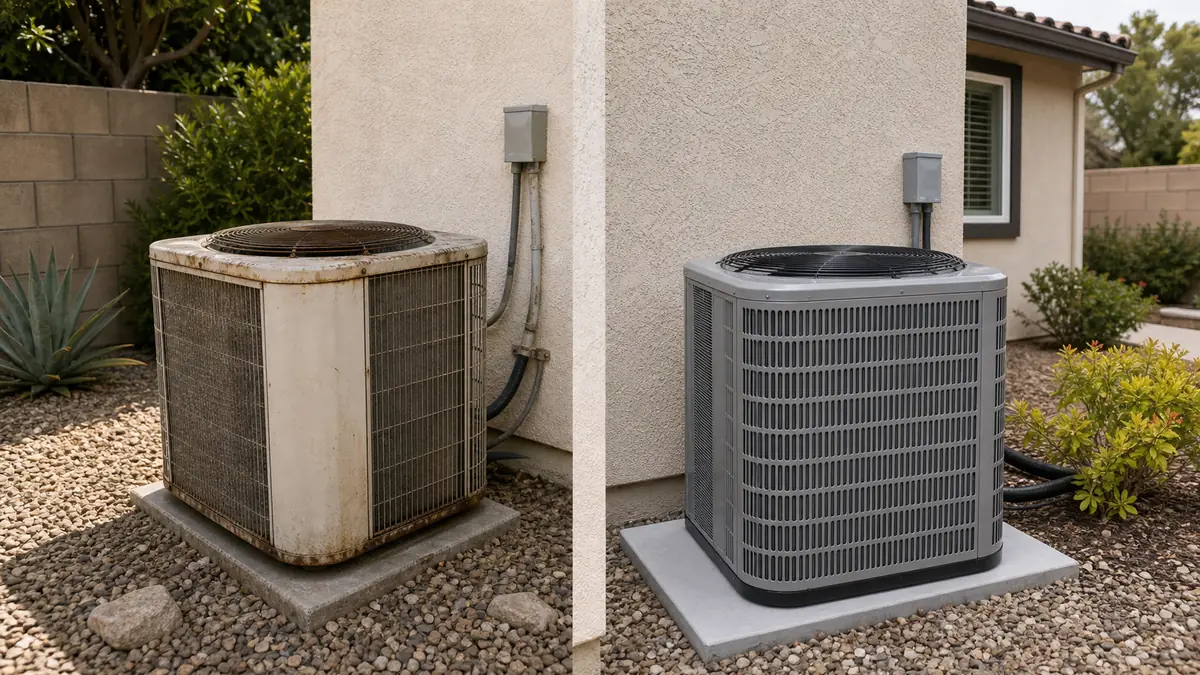
What are the two rules that actually decide this?
Clear away the pitch and two plain tests settle most of these calls. Test one, the half-cost line: when a single repair would run past roughly half the price of a comparable new system and the unit has already aged past 10 to 12 years, replacing it usually beats nursing the old machine along. Test two, the age-by-cost line: multiply the unit's years by the repair price in dollars, and a product over about 5,000 argues for replacement. Run the math, a 14-year-old unit facing a 600 dollar repair lands at 8,400, well past the line, while a 6-year-old unit with that same 600 dollar repair lands at 3,600, safely under it. Neither line is gospel, but side by side they keep you from sinking real money into a system living on borrowed time.
How do common failures fall out?
Most service calls are clearly a repair. The decision only gets hard on a handful of expensive, sealed-system failures. Here is how the usual Burbank failures sort, using 2026 SoCal repair lanes.
| Failure | Repair lane | Typical call |
|---|---|---|
| Run/start capacitor | $150 - $450 | Repair, almost always |
| Contactor | $150 - $450 | Repair |
| Condensate drain / pump | $120 - $450 | Repair |
| Refrigerant leak + recharge | $225 - $1,500 | Repair if young; weigh if old/recurrent |
| Inverter / control PCB | $400 - $2,000 | Weigh against unit age |
| Compressor (out of warranty) | $1,200 - $3,500 | Often replace if past ~12 years |
Replacement lanes for context: central AC about 5,000 to 12,000 dollars, ducted heat pump about 6,000 to 16,000 dollars, single-zone ductless about 3,500 to 8,000 dollars. Put a 3,000 dollar compressor against a 14-year-old condenser and both rules say replace; put a 400 dollar board against a 7-year-old unit and both say repair.
Can you run three worked Burbank examples?
The rules are easier to trust once you see them applied to real numbers. Here are three calls we run constantly on the valley floor, with both tests shown.
Example one: 7-year-old MUZ condenser, blown run capacitor. The repair is about $250. Half-cost test: a $250 fix is nowhere near half a $4,000-plus replacement, and the unit is well under 10 years. Age-by-cost test: 7 years times $250 is $1,750, far under the $5,000 line. Both rules agree, repair it, and you have years of life left. We would not even raise replacement here.
Example two: 11-year-old single-zone system, refrigerant leak at the coil plus a tired contactor. The repair quote lands around $1,400 once you find the leak, repair the joint, recharge, and swap the contactor. Half-cost test: $1,400 against a roughly $5,500 single-zone replacement is about 25 percent, under half, but the unit is at the edge of the age window. Age-by-cost test: 11 times $1,400 is $15,400, well over $5,000. The rules split, which is exactly the borderline case, so the deciding factors become how the rest of the system looks and whether the leak is the first or the third on that coil. A first leak: repair and watch it. A recurring leak: lean replace.
Example three: 14-year-old condenser, failed inverter board and a weak compressor. The repair runs $2,800 or more. Half-cost test: $2,800 against a $6,000 ducted-inverter replacement is nearly half, on a 14-year-old unit past the age window. Age-by-cost test: 14 times $2,800 is $39,200, far over the line. Both rules say replace, decisively, and pouring that much into a unit that will likely fail again next summer is throwing good money after bad.
| Case | Half-cost test | Age x cost test | Call |
|---|---|---|---|
| 7 yr, $250 capacitor | Far under half | $1,750, under $5,000 | Repair |
| 11 yr, $1,400 leak + contactor | ~25%, under half | $15,400, over $5,000 | Borderline; depends on leak history |
| 14 yr, $2,800 board + compressor | ~Half, unit is old | $39,200, over $5,000 | Replace |
How does the Burbank climate shift the answer?
The valley floor's long cooling season changes the efficiency side of the equation. A system here runs through roughly 40 to 55 days a year at or above 90 F, far more duty than a coastal home, so the gap between an old single-stage condenser and a modern Mitsubishi inverter that modulates to match the load shows up as a bigger annual dollar difference. That does not mean replace everything, but it does mean that when a borderline old unit needs a significant repair, the energy savings from a high-SEER2 replacement carry more weight in Burbank than they would somewhere milder. The high energy bill page shows where those savings come from.
What about warranty, rebates and the in-between options?
Three things can change a close call. First, warranty: if a major part fails while the unit is still under Mitsubishi's parts-and-labor coverage, the repair may be labor-only through authorized service, which can swing it back to repair, so we always check the model and serial first. Second, rebates: a state or utility incentive can take the edge off a replacement you already needed, but for 2026 the federal 25C credit is off the board and the LADWP, SCE and TECH programs cycle through rounds that may already be reserved, so we confirm each one live before we let it sway the number. Third, the in-between: sometimes the smartest move is neither a like-for-like repair nor a full central replacement, but a ductless retrofit that solves a comfort problem the old ducted system never could. The buying guide covers those equipment choices.
| Unit age | Repair size | Lean |
|---|---|---|
| Under 8 years | Any single repair | Repair |
| 8-12 years | Minor (capacitor, drain) | Repair |
| 8-12 years | Major (compressor, board) | Weigh both rules |
| Over 12 years | Major | Usually replace |
| Over 12 years | Recurrent small repairs | Plan replacement |
What hidden costs change the replacement number?
A replacement quote is rarely just the equipment, and the extras are where a fair comparison lives or dies. On a Burbank job the line items that move the number are: an electrical panel or circuit upgrade if you are converting from gas to a heat pump and the panel is full, which is common in a 1940s cottage; duct sealing with HERS field verification the moment you touch the ductwork on a ducted swap, which Zone 9 Title-24 generally triggers; refrigerant-charge and airflow verification on any new split system; the permit itself; and line-set routing through plaster and lath, which takes longer than punching modern drywall. When we quote a replacement against your repair, we put those on the table so you are comparing a real all-in install price to the repair, not a bare-equipment number to an all-in repair. The flip side: a like-for-like repair almost never carries those costs, which is part of why a young unit with a small fault is such an easy keep.
| Add-on | When it applies | Typical lane |
|---|---|---|
| Duct sealing + HERS verification | Any ducted alteration in Zone 9 | $800 - $3,100 |
| Electrical / panel upgrade | Gas-to-heat-pump on a full panel | Varies; can be significant |
| Charge + airflow verification | New or replacement split system | Folded into the install |
| New ductwork | Old or undersized ducts on a swap | $1,900 - $6,000 |
Is there a third option besides repair and replace?
Often, yes, and on Burbank's pre-war stock it is frequently the best move. When an old ducted system fails on a 1930s cottage that never had good ducts to begin with, the choice is not only "fix the old box" versus "drop a new box on the same bad ducts." A ductless Mitsubishi retrofit solves a comfort problem the ducted system never could: it zones the house, skips the leaky attic ducts entirely, and runs quiet on an inverter. So a borderline repair-or-replace call on an old ducted unit sometimes resolves into a ductless conversion that costs in the same range as a ducted replacement but delivers comfort the original system could not. That is a house-specific judgment, not a rule, and it is exactly the kind of call the buying guide and the installation page are built to walk through with you.
How do you decide without overselling me?
We put the numbers on the table and let them decide. On site we identify the failed part, quote the repair, state the unit's age, and run both rules out loud. If a 400 dollar fix gives you five more good years, we say so and do the repair. If you are about to spend 2,500 dollars on a 15-year-old condenser that will fail again next summer, we say that too, and show you the replacement lane and any rebate worth chasing. An independent shop's whole value here is that we do not earn more by steering you wrong. When you are ready, book a Burbank assessment.
Common questions about repair versus replace
What is the rule of thumb for repair versus replace?
We lean on two. The first: once a single repair runs past roughly half what a new system costs, and the unit has already crossed 10 to 12 years, replacing it usually comes out ahead. The second: take the unit's age in years times the repair price, and if that product tops about 5,000, the scale tips toward replacement. Neither is law, but read together they keep you from feeding cash into a machine on its way out.
My AC is 9 years old and needs a capacitor. Fix it, right?
Almost certainly fix it. A capacitor on a 9-year-old unit is a 150 to 450 dollar repair on a system with years of life left, nowhere near the replacement threshold. Replacement only enters the conversation when the failure is major (compressor, coil leak, inverter board) and the unit is old.
Does the long Burbank cooling season change the math?
Yes, it tilts slightly toward replacement for old, inefficient units. Because the system runs through 40-plus days above 90 F, an aging single-stage condenser wastes more energy here than the same unit would in a mild climate, so the efficiency gain from a modern Mitsubishi inverter is worth more per year.
Is it worth replacing just to get a rebate?
On its own, no, and least of all in 2026. The 25C federal credit closed at the end of 2025, and the state and utility offers move in rounds that can sit reserved or paused. A rebate is a fair sweetener on a replacement you already had coming, but tearing out a perfectly repairable unit to chase an incentive nobody has confirmed is the wrong reason to spend.
Related: buying guide, installation, and high energy bills.