Mitsubishi Ducted Air Handlers (SVZ, MVZ, SEZ) in Burbank
Straight answer: Burbank Mitsubishi HVAC installs and services Mitsubishi SVZ, MVZ and SEZ ducted air handlers for Burbank homes in 91506 and the Burbank Hills, so call (213) 513-5256 or book online. A ducted inverter system runs about $6,000 to $16,000 and gives whole-home comfort with no visible wall heads; we test the ducts first so the rating reaches the rooms.
Key facts
- Model families: SVZ-KP and MVZ-A multi-position air handlers; SEZ-KD low-static slim-duct concealed units.
- Driven by a Mitsubishi inverter outdoor unit; keeps existing registers and hides the equipment.
- Ducted inverter system install typically $6,000 - $16,000 depending on duct condition.
- Best for Burbank Hills ranches and larger Rancho Equestrian homes that want whole-home, not per-room, control.
- Ducts get leakage-tested and sealed first, and where Title-24 applies the result is HERS-verified.
- Independent service; in-warranty units to authorized service first.
What is a ducted Mitsubishi air handler?
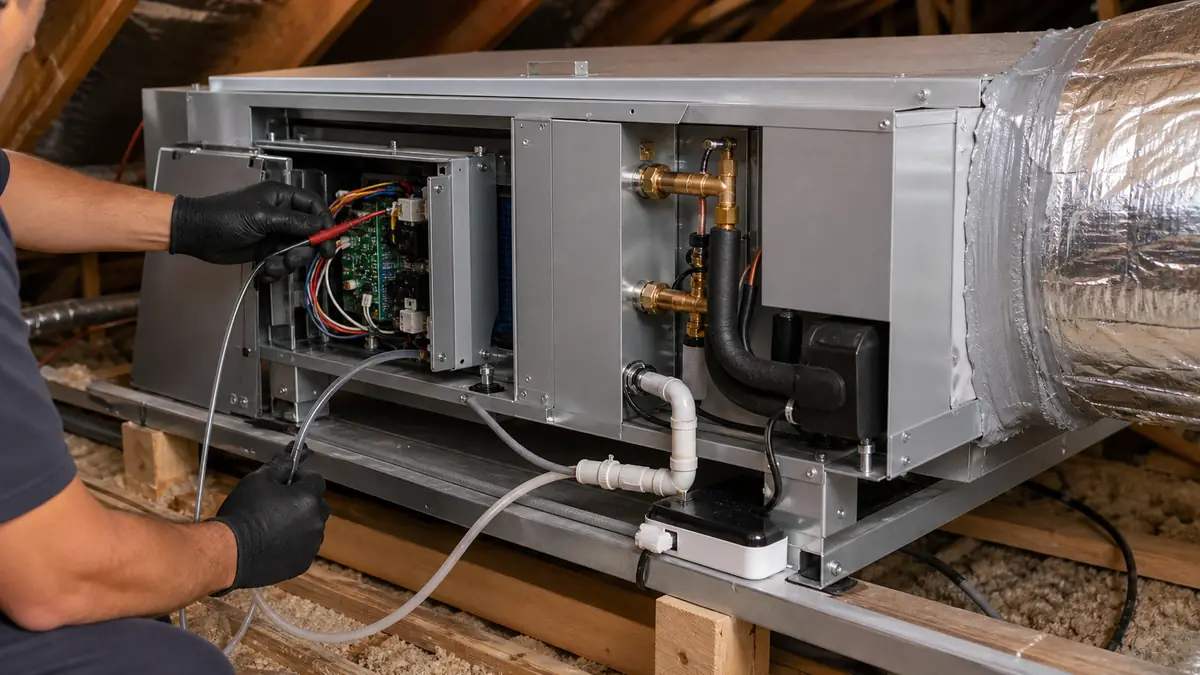
Most people picture a wall head when they hear mini-split, but Mitsubishi also makes concealed ducted units. The SVZ-KP and MVZ-A multi-position air handlers install in a closet, attic or garage and connect to ductwork, running off the same quiet inverter outdoor unit that drives a wall head. The SEZ-KD is a slim, low-static version for short runs in a soffit. The point is whole-home conditioning with no visible indoor equipment, which appeals to owners of larger Burbank Hills ranches and Rancho Equestrian District homes who do not want a head in every room.
SVZ, MVZ or SEZ, which fits my Burbank house?
| Unit family | Example models | Best for | Notes |
|---|---|---|---|
| SVZ-KP multi-position | SVZ-KP24NA | Whole-home ducted, larger Burbank homes | High external static, pairs with inverter condenser |
| MVZ-A multi-position | MVZ-A24AA7 | Whole-home ducted, flexible mounting | Up/down/horizontal mounting for tight mechanical spaces |
| SEZ-KD slim-duct | SEZ-KD12NA4 | One zone, low ceilings, short runs | Hides in a soffit; great for open living-dining |
| PEAD / PVA (P-Series) | PEAD-AA24NL, PVA-A36AA7 | Larger residential, light commercial | Newer single-zone ducted uses R-454B refrigerant |
If you would rather have independent per-room set points, a multi-zone wall or floor-head design may serve you better; compare with the floor-mount console page and the installation overview.
What faults show up on a ducted Mitsubishi system?
A ducted air handler reports through the same P/E/U code scheme as a wall head, read on the kumo cloud app or the PAR wired controller. These are the families we see most, and the component each one points at.
| Code | What it means | Component / first check |
|---|---|---|
| P4 / P5 | Drain sensor or drain pump fault, high condensate | Condensate pan, drain pump, float, drain line |
| P6 | Freeze or overheat protection | Dirty filter, blocked coil, low airflow |
| P1 / P2 / P9 | Indoor thermistor open or short | Intake (TH1), liquid-pipe (TH2), coil (TH5) sensors |
| E6 - E9 / EA / EB | Indoor-outdoor communication fault | S1/S2/S3 wiring and terminals, control PCB |
| U7 / P8 | Low refrigerant / abnormal pipe temperature | Flare-joint leak, LEV/EEV, recharge |
| U6 / U8 | Outdoor compressor or fan-motor fault | Inverter PCB, DC compressor, outdoor fan motor |
What fails on a ducted Mitsubishi system, and what does it cost?
The high-value failures are the variable-speed ECM blower in the air handler and the inverter or control board. An ECM blower or module runs roughly 450 to 2,300 dollars; an inverter PCB lands around 400 to 2,000 dollars on Mitsubishi systems. Lower-cost issues are a clogged condensate drain (codes P4 / P5), a dirty filter tripping freeze or overheat protection (P6), or a loose S1/S2/S3 connection throwing a comm error (E6 through E9). We read the code on the kumo app or wired controller before opening anything.
Ducted air handler or individual wall heads?
This is the real decision, and it is a genuine tradeoff rather than a clear winner. A ducted SVZ or MVZ hides all the indoor equipment and feeds several rooms off shared ductwork, which keeps a period Burbank Hills ranch looking original and gives even, quiet whole-home conditioning. What you give up is true per-room control: the ducted system runs the house off one set point, where a multi-zone wall-head design lets you cool the bedrooms and ignore the empty front room. Ducted also depends entirely on duct quality, so it carries the duct-sealing cost a ductless retrofit skips. As a rule of thumb in Burbank: keep-the-registers ranch with sound ducts leans ducted; plaster-walled cottage with no usable duct chase leans ductless wall or floor consoles.
What does a ducted retrofit involve in a Burbank home?
The install hinges on where the air handler can live and what the existing ducts are worth. In a post-war Burbank ranch we usually set an SVZ or MVZ in the original furnace closet or the attic platform, reuse the register layout, and run a slim line set out to the side-yard inverter condenser. The catch in this housing stock is duct condition and clearance: a 1950s attic can be low and the original flex brittle, so we test leakage first and budget sealing or partial replacement into the job. The SEZ slim-duct unit is the answer for a low-ceiling cottage where a full air handler will not fit, conditioning one open zone through a short soffit run. Whatever the layout, a Zone 9 permit brings the Title-24 charge-and-airflow verification, which we fold into the schedule.
Why do the ducts matter so much here?
A ducted inverter only pays off if the ducts hold their air. Burbank's older homes frequently leak 20 to 30 percent through brittle joints in a 130 F attic, which quietly cancels the efficiency you paid for. We measure the leakage, seal or swap out whatever is failing, and where Title-24 requires it the result gets HERS-verified. The full duct story is on the duct repair and sealing page.
Common questions about Mitsubishi ducted air handlers
What is a ducted mini-split, versus the wall units I usually see?
It is a Mitsubishi inverter system that connects to ductwork instead of a visible wall head. An SVZ or MVZ multi-position air handler sits in the closet, attic or basement and pushes conditioned air through registers, so a Burbank Hills ranch keeps its existing look while gaining inverter efficiency and quiet operation.
Can an SEZ slim-duct unit fit my low Burbank ceiling?
Often, yes. The SEZ-KD low-static concealed unit is built for short duct runs in a soffit or dropped ceiling, which suits the modest ceiling heights in many post-war Burbank homes. It conditions one zone, like an open living-dining area, without a wall head.
Why would I pick ducted over individual wall heads?
Looks and whole-home evenness. Some homeowners do not want a head in every room; a single ducted air handler hides the equipment and feeds several rooms off shared ductwork. The trade-off is you lose true per-room set points, so we weigh it against a multi-zone wall-head design for your floor plan.
Do my old ducts need work before a Mitsubishi air handler goes in?
Usually some. A high-efficiency SVZ or MVZ inverter on leaky 1950s ducts wastes its rating. We measure leakage up front and seal or repair whatever is needed, bringing in HERS verification when Title-24 calls for it, so the new system truly reaches the rooms.
What refrigerant do these ducted Mitsubishi systems use?
Legacy M-Series SVZ and MVZ air handlers run on R-410A, while the newer single-zone ducted P-Series systems (PUZ-AK..NLHZ paired with PEAD-AA..NL slim duct) have moved to R-454B. It matters for any leak or recharge work, because the two refrigerants are not interchangeable. We confirm which one your system uses before opening the circuit.
Can one ducted air handler heat as well as cool my Burbank home?
Yes. The SVZ and MVZ air handlers run off a Mitsubishi inverter heat-pump condenser, so the same system cools through a 95 F July and heats on the few cold Burbank mornings. Pairing it with a Hyper-Heat outdoor unit makes it a clean single-system replacement for an aging gas furnace and AC together, which is a common Burbank Hills retrofit.
Related: the heat pump that drives these air handlers, kumo cloud controls, and fault codes.